USAC's Rate Field Bug Left Carrier Claims Incomplete. Here's Why That Still Matters

On April 23, 2026, USAC posted a notice that most carriers read once, assumed was a nothing-burger, and moved on. The rate field in the Lifeline Claims System wasn't pre-populating for data months where no original claim had been filed. All data months were affected. The issue was resolved within a day or so.
I'm guessing your team saw that notice, maybe forwarded it to someone, and that was the end of it.
Here's the problem: that bug was probably creating incomplete claims for months before anyone noticed. And if your team filed original claims during a window when the rate field wasn't auto-filling, those claims went out with missing or manually entered rates. That is exactly the kind of thing an FCC auditor flags.
I talked to two carriers last week who didn't even realize they had a potential exposure until I mentioned it. Neither had gone back to check their original submissions. One of them, a mid-size regional operator out of Texas, told me they'd filed at least forty claims during the period in question without noticing the field was blank.
This is the part that gets me. The system told them everything was fine. No errors, no warnings, no "please review before submitting." Just a blank field that happened to work most of the time because USAC's back-end had historical data to pull from for most carriers.
But for data months where there was genuinely no prior claim? The field sat empty. And if someone on your billing team didn't manually populate it, your claim went in incomplete.
The filing timestamp is what matters, not the fix date
USAC's LCS notice said the bug was resolved as of April 23. That doesn't retroactively fix the claims that went out incomplete before then. Those submissions are timestamped. The data in them is the data that matters for compliance purposes.
Here's how this likely played out across the industry. A carrier submits their monthly claim. If it's a data month with an existing claim on file, USAC's system pulls the rate from that prior submission and pre-populates the field. Clean, no friction. But if it's a fresh data month, say a new service category or a subscriber base that hadn't previously filed for that particular benefit type, the pre-population fails. Someone has to type it in. Most carriers probably did. But some number of claims went out with either blank rate fields or manually entered rates that didn't match what USAC's records actually had on file for that subscriber class.
When the FCC does a program integrity review, or when USAC runs a random audit, they pull your submitted claims and cross-reference them against the National Verifier and NLAD records. A claim with a rate that doesn't match the subscriber's documented benefit level is a flag. Not an automatic disqualification, but a flag that says "this claim needs closer review."
And "needs closer review" is where costs start piling up.
What an FCC audit actually looks like for carriers
I want to be specific here because vague warnings about compliance audits don't land the way concrete scenarios do.
The FCC's program integrity reviews for Lifeline carriers typically look at three things: eligibility documentation, enrollment timing, and claim accuracy. The claim accuracy piece is where the rate field issue lives.
When an auditor pulls your LCS submissions, they're looking at every rate you claimed against every subscriber's documented benefit level. If a subscriber is on the $9.25 basic benefit and you filed at $9.25, that reconciles cleanly. If you filed at a different rate, or if the rate field was blank and you've got no documentation showing how you derived the number, that subscriber's claims for the period in question get flagged.
Now multiply by your active subscriber count. For a carrier with 12,000 Lifeline subscribers, even a 2% error rate on rate field accuracy means roughly 240 subscribers with potentially problematic claims. Each one represents a month of claims that may need to be repaid or explained. At $9.25 per subscriber per month, that's $2,220 in exposure for a single month, but the FCC typically looks at a 12-month certification period. Do the math on a full year and you've got real money on the table.
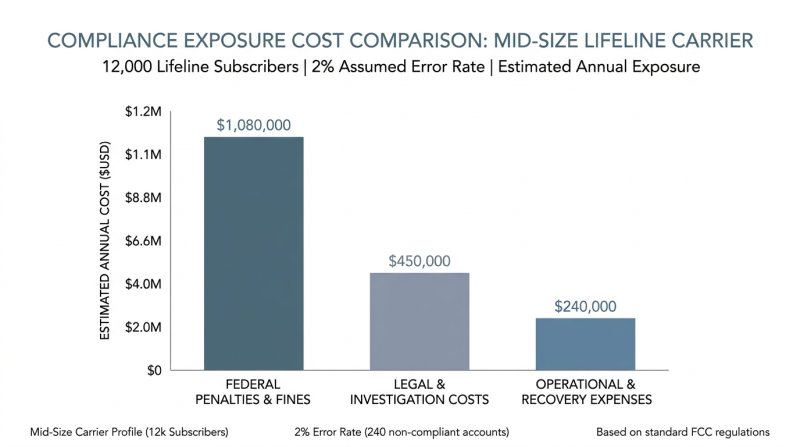
Some carriers I've talked to assume "we filed correctly, we're fine." That's probably true for most of the industry. But "probably" doesn't protect you in an audit. Having a systematic audit workflow that can go back and check your submissions against NLAD records before an auditor does? That protects you.
One thing I should clarify: the FCC doesn't typically audit every carrier every year. They're strategic about it. They focus on carriers with high error rates in their submissions, carriers who have been flagged by USAC's internal monitoring, and carriers who happen to be on the wrong end of a subscriber complaint that gets escalated. The rate field bug doesn't automatically put you in any of those categories. But if you've got 240 subscribers with rate discrepancies sitting in your LCS history and an auditor happens to pull your file for any reason, those 240 subscribers become the audit sample. And when they look at those 240, they might expand the sample. It's not a fun conversation when it happens.
The workaround nobody talks about
Here's what I've seen carriers do when they find this kind of issue in their own submissions.
Option one: submit amended claims. USAC does allow correction filings, but the process is not exactly streamlined. You need to identify which data months are affected, pull the original submissions, determine what the correct rate should have been, and file corrections. For a carrier with thousands of subscribers and 18 months of historical submissions, this is a weeks-long project if you're doing it manually. And that's assuming you can even identify which specific subscribers were affected. The LCS submission data doesn't always tell you whether the rate field was auto-populated or manually entered. You might have to cross-reference submission timestamps against USAC's system logs to figure out which claims went out during the window when pre-population was broken.
Option two: eat the exposure and hope it doesn't come up. I've heard this one too. The carriers who take this approach are betting that the FCC's audit focus is elsewhere, or that their error rate is small enough to fall below the threshold that triggers enhanced scrutiny. That's a strategic risk calculation each operator has to make. I will say that the FCC's 2026 NPRM on program integrity suggests enforcement focus is increasing, not decreasing. The FCC has been explicit about wanting to tighten the compliance requirements for Lifeline carriers, and the Notice of Proposed Rulemaking from February 2026 lays out enhanced verification requirements that, if adopted, would make the kind of rate field discrepancy I'm describing a bigger problem than it is right now.
Option three: build a retrospective check into your audit workflow. Pull your LCS submissions for the period in question, cross-reference against NLAD subscriber records, identify the delta between what you filed and what should have been filed, and document your findings. If an auditor shows up, you can say "we identified this discrepancy during an internal review, here's our analysis, here's the remediation." That's a materially different conversation than "we didn't know there was an issue."
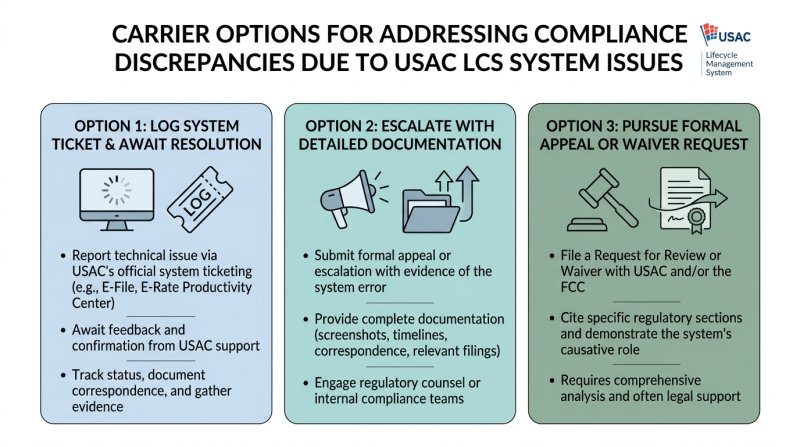
The carriers I've seen handle this best are the ones who already had an audit workflow running. Not because they knew about the rate field bug specifically, but because they run quarterly reconciliation checks as standard practice. When the USAC notice dropped on April 23, they already had a process to evaluate whether it affected them.
The lifecycle of a carrier that doesn't check
I want to walk through a hypothetical that I think illustrates the actual risk here. This is the kind of thing I've seen play out at multiple carriers, not just with the rate field bug specifically but with similar system-level issues that created hidden compliance gaps.
Carrier A is a mid-size regional operator. They manage about 8,500 Lifeline subscribers across three states. They've been filing LCS claims monthly for three years without major issues. When USAC posted the April 23 notice about the rate field pre-population failure, their compliance team forwarded it to their billing manager, who skimmed it, concluded it didn't affect them because they always file early in the month, and moved on. They didn't check whether any of their submissions during the affected period had missing or incorrect rate data. They didn't pull their submission history to verify. They just assumed it was fine.
Now it's October 2026. The FCC has notified Carrier A that they're conducting a program integrity review. The auditor pulls Carrier A's LCS submissions for the past 12 months. They find 47 subscribers where the claimed rate doesn't match the documented NLAD benefit level. Some of those subscribers had blank rate fields in the original submission. Others had manually entered rates that were $2-3 above or below what the NLAD records say they should have been.
Carrier A now has two problems. First, they have to repay the difference between what they claimed and what they should have claimed for those 47 subscribers across the audit period. That's real money. Second, they have to explain to the FCC why their certified Form 481 filing was inaccurate. The FCC's enforcement office is now involved because the certification language in the Form 481 is a legal representation, not a formality.
Carrier A's compliance consultant tells them they should have caught this during an internal review. The FCC's enforcement staff asks why they didn't. Carrier A's answer is "we didn't know the issue existed until you told us." That's not a great answer. It's not an answer that produces a clean outcome.
The total cost of this scenario for Carrier A includes the repayment obligation, legal and consulting fees, staff time spent responding to the audit, and whatever enforcement action the FCC decides to pursue. I've seen similar situations result in six-figure repayment obligations plus compliance sanctions. And the carriers involved almost always say the same thing: we wish we'd found it first.
What this means for your next FCC Form 481 filing
The FCC Form 481 certification requires carrier attestation that all submitted claims are accurate and supported by documentation. If your LCS submissions during the affected period had incorrect or missing rate data, and you certify that the filing is accurate, that's a compliance exposure point.
The certification language in Form 481 is not boilerplate. It has teeth. When you sign that attestation, you're telling the FCC that your claims are accurate. If a subsequent audit shows they weren't, the FCC has grounds to move on enforcement actions.
I talked to a compliance consultant last month who put it this way: "Most carriers think of the Form 481 certification as a checkbox. The FCC thinks of it as a legal representation. Those two things are not the same."
Your risk here isn't just the rate field bug specifically. It's the pattern it represents. Systems fail. USAC's systems fail. Your own systems fail. The question is whether you have visibility into those failures before someone else finds them for you.
The 2026 filing season is open right now. The window runs through July 1. If you're in the middle of preparing your Form 481 and you haven't audited your LCS submissions for the period in question, this is the week to do it. Not because the rate field bug is definitely going to hurt you, but because if it does hurt you and you haven't checked, you're going to be explaining that to the FCC with no remediation story to offer.
The 30-second audit case
I'm going to be direct about what ProofIQ's audit workflow does here because it directly addresses what I've been describing.
Verda, our FCC/USAC eligibility audit tool, runs a retrospective check against NLAD records and LCS submission data. It identifies subscribers where the claimed rate doesn't match the documented benefit level. It flags the data months affected and generates a discrepancy report that your compliance team can use to evaluate remediation options, including whether amended claims need to be filed.
This isn't theoretical. This is the exact scenario I've been walking through. The rate field bug exposed a gap in carrier visibility. Carriers who can identify and address that gap quickly are in a materially better position when audits happen.
The tool runs the comparison in about 30 seconds for a typical mid-size carrier. The output is a structured report, not a vague summary. You can take that report to your compliance team, use it to prepare corrected filings if needed, and document your remediation effort if an auditor asks.
Here's what that actually looks like in practice. You connect Verda to your LCS submission data and your NLAD subscriber records. The system runs the comparison and produces a structured output: subscriber ID, data month, claimed rate, documented rate, variance. Your compliance team reviews the variance report and determines which discrepancies require remediation. For the ones that do, you have documented evidence that you identified the issue, analyzed it, and took corrective action. That's the story you tell an auditor.
Is it the whole story? No. You still have to do the remediation work. But the documentation trail is there, and the identification and analysis work is done, and that is genuinely most of the heavy lifting in an audit response.
Practical next steps for carriers
If you're reading this and wondering whether you should check your own LCS submissions, the answer is probably yes. Here's a quick list of what that check would involve:
Pull your LCS submission history for the past 12 months. For each data month, identify whether the rate field was pre-populated or manually entered. For manually entered rates, verify the rate matches the subscriber's documented NLAD benefit level. If you find discrepancies, determine whether amended claims need to be filed and what the repayment exposure is. Document your findings and remediation steps.
You can do this manually with a spreadsheet. It's tedious and slow. Or you can run it through an automated audit workflow, which is faster and leaves a documented trail.
One thing I'll be honest about: the spreadsheet approach works for carriers with a few hundred subscribers. For carriers with thousands of subscribers and years of submission history, it's not realistic. You're talking about thousands of cross-references across dozens of data months. The manual approach is too slow and too error-prone to be useful. An automated workflow is the only thing that makes sense at scale.
The carriers who are going to come out of this in the best shape are the ones who ran that check this week, not the ones who are still deciding whether to look into it.
The uncomfortable question
Here's the thing nobody in the telecom compliance space wants to say out loud: most carriers are probably not in full compliance with everything USAC and FCC require at any given moment. The regulations are complex. The systems are imperfect. The documentation requirements are tedious. And the enforcement actions tend to focus on the worst actors, which means there's a reasonable argument that if you're not maximally compliant but you're also not actively being audited, you're probably fine.
That's a real risk calculation. I'm not here to tell you it's wrong.
But I'll tell you this: the carriers who get caught are usually the ones who didn't know they had a problem until it showed up in an audit finding. The carriers who handle audits well are the ones who found the issue first.
The rate field bug was a USAC system failure. It created potential compliance gaps for carriers across the Lifeline program. Whether those gaps matter for your operation depends on what you filed and whether you've checked.
Check your submissions. That is the whole point of what I'm saying here.
Frequently Asked Questions
What was the USAC LCS rate field bug? Between approximately January and April 23, 2026, the Lifeline Claims System rate field was not pre-populating for data months where no original claim had been submitted. USAC resolved the issue on April 23, but claims filed during the affected window may have missing or incorrect rate data.
How do I know if my carrier's submissions were affected? Pull your LCS submission history for the past 12 months and check whether any data months had blank rate fields or manually entered rates for subscribers whose benefit levels should have auto-populated from prior submissions. If you filed original claims for new service categories or subscriber groups during the affected period, those are the most likely to be impacted.
Does a blank rate field automatically mean non-compliance? Not automatically. But if a subscriber's claimed rate doesn't match their NLAD-documented benefit level and you can't document how you derived the number, that's a compliance flag in an FCC audit. The burden is on the carrier to demonstrate claim accuracy.
Can I file amended claims to fix this? Yes. USAC allows correction filings, but the process requires identifying affected data months, pulling original submissions, determining correct rates, and filing corrections. For large carriers with years of submission history, this is a substantial project.
What is the FCC looking at in program integrity reviews? The FCC reviews three primary areas for Lifeline carriers: eligibility documentation, enrollment timing, and claim accuracy. Rate discrepancies that can't be explained are the specific type of issue the rate field bug could have created. USAC's internal monitoring systems flag carriers with high error rates, and those carriers tend to draw enforcement attention.
If you want to see how ProofIQ's audit workflow handles retrospective LCS reconciliation, you can request a demo. We can walk through the process with your actual submission history and show you what a discrepancy report looks like.
This post reflects information available as of April 25, 2026. USAC's LCS notice from April 23 is the primary source for the system issue described. FCC Form 481 filing requirements and program integrity audit procedures are subject to change; consult current FCC guidance for your specific situation.